
The Rise of XEO: Why Communications Is Now an AI Discovery Function
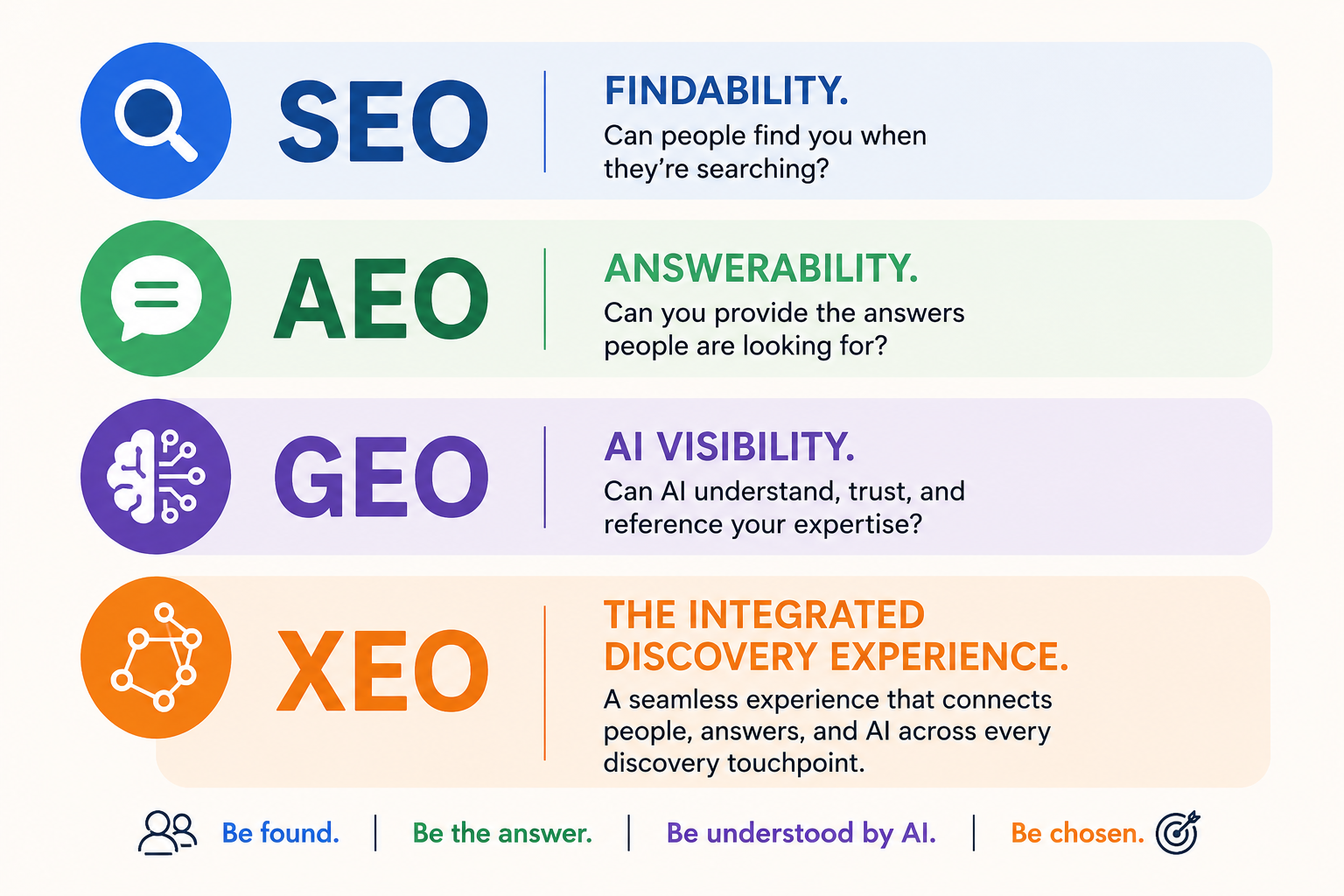
Before XEO entered the building, last year I wrote a blog piece introducing GEO (Generative Engine Optimization) and how it plays nicely in the sandbox with SEO (Search Engine Optimization). SEO was the answer to everything. Pick the right keywords. Build backlinks. Climb the rankings.
Then people stopped searching the way they always had…with Google.
They started asking Alexa. Talking to Siri. Looking for featured snippets that answered their questions without another click. That’s when AEO (Answer Engine Optimization) entered the conversation, helping brands structure content to become the answer.
Then GEN AI arrived. Suddenly, the question shifted again: How do I show up in ChatGPT, Perplexity, and AI-generated recommendations? Enter GEO (Generative Engine Optimization).
Which brings us to the now with XEO (Experience & Engine Optimization): How do I get discovered wherever and however people seek answers, recommendations, and expertise?
With XEO as the new darling of digital marketing, I thought I’d break down why PR is now a critical driver of AI discovery.
XEO: Experience & Engine Optimization
XEO is a sister framework of SEO, GEO and AEO aiming to optimize a brand’s digital presence across various discovery touchpoints simultaneously: cross-engine search, social search, platform-specific (eg., Amazon, Siri) and a website to enhance the overall experience.
And real talk if you haven’t noticed. The traditional buyer journey is now an AI buyer journey. Take a minute. How do you search today when looking for a product or for an answer to something? ChatGPT? Perplexity? Claude?
Discovery has fragmented. And brands and B2B businesses must evolve with it.
From Websites to Discovery Engines
Websites typically operate as static places to validate a buying decision after someone already knows who you are.
In the age of AI, your website has to perform for both humans and AI agents to be discovered. People aren’t going to websites to learn about a brand or its product. They are prompting questions for AI agents to serve up answers based on the content on that site that AI agents pull from to get the answer to the prompt.
It’s speaking to AI models. And informing search engines. As well as shaping how AI-generated answers describe your brand.
That means building experiences that answer questions before they’re asked.
Content that teaches instead of sells. Pages that connect ideas rather than simply list features. Signals that establish credibility, expertise, and trust.
Because AI doesn’t just retrieve information. It synthesizes it.
Why PR Suddenly Matters More
This shift creates a massive opportunity for communicators.
The communications assets we’ve spent years building weren’t designed for this moment, but they’re perfectly suited for it. FAQs fuel answer engines. Earned media builds authority. Thought leadership shapes AI understanding. Customer stories provide validation. Together, they create the signals that influence how brands are surfaced, cited, and recommended.
From Awareness Metrics to Discoverability Metrics
For years, communications teams measured success through awareness, reach, impressions, and share of voice. Those metrics still matter, but their role is evolving.
Today, every media interview, contributed article, executive perspective, customer story, analyst briefing, and research report contributes to something bigger: brand discoverability.
How AI Determines Who Gets Recommended
AI systems don’t create recommendations out of thin air. They look for patterns of credibility, expertise, authority, and trust across the web. The same signals journalists, analysts, buyers, and industry influencers have always relied on are increasingly shaping how AI engines understand and reference brands.
This is where communications becomes a strategic business function rather than a support function.
PR isn’t simply generating coverage. It’s creating authoritative signals that help brands become part of the conversations, answers, and recommendations shaping modern buying journeys.
Communications Is Now a Discovery Function
Thought leadership isn’t just content. It’s training the market on what your company knows.
Earned media isn’t just awareness. It’s third-party validation.
Customer stories aren’t just proof points. They’re trust signals.
Research reports aren’t just campaigns. They’re sources of authority.
In an AI world where discovery happens across XEO such as search engines, answer engines, AI assistants, social platforms, analyst reports, communities, and websites, communications has become one of the most important drivers of visibility, trust, and influence.
Building Trust at Machine Scale
The brands that win won’t be the ones publishing the most content or chasing every algorithm update. They’ll be the brands that consistently contribute expertise, answer meaningful questions, and create valuable experiences that earn attention, trust, and recommendation.
The Future Belongs to Discoverable Brands
The future of discoverability sits at the intersection of experience, expertise, authority, and trust. And that’s a space communications professionals have been building toward all along.
The opportunity now is to stop thinking about PR, content, SEO, AEO, and GEO as separate disciplines and start viewing them as connected systems within a larger discovery ecosystem.
The brands that stand out will be the ones that are understood, trusted, cited, recommended—and ultimately discovered.
Communications is no longer just shaping narratives. It’s shaping discoverability.